Therapy Services
At C3MH, we offer a range of therapy services tailored to meet diverse needs, including individual, group, family, and couples therapy, as well as trauma-focused cognitive behavioral therapy and peer support. Our dedicated team understands that each client is unique, providing personalized approaches that foster healing and growth. Through active listening, emotional support, and collaborative goal setting, we create a safe environment where clients can explore their challenges, build resilience, and develop practical coping strategies. Whether working one-on-one or within a community setting, our mission is to empower individuals and families to thrive.

INDIVIDUAL THERAPY
INDIVIDUAL THERAPY

GROUP THERAPY
GROUP THERAPY

FAMILY THERAPY
FAMILY THERAPY

COUPLES THERAPY
COUPLES THERAPY

PARENT-CHILD INTERACTION THERAPY
PARENT-CHILD INTERACTION THERAPY

TFCBT THERAPY
TFCBT THERAPY

Individual Therapy
Individual Therapy provides one-on-one support in a safe, confidential setting where clients can explore their thoughts, emotions, and challenges. Guided by a licensed therapist, sessions focus on developing coping strategies, improving mental well-being, and fostering personal growth. Our Treatment Individual therapy isn’t one single method—it’s a custom mix of approaches tailored to the person, their goals, and what they’re going through. Here are the most effective, commonly used treatment methods you we offer: Solutions focused
- Focuses on solutions rather than problems
- Builds on strengths and past successes
- Sets clear, achievable goals
Best for: short-term goals, motivation, life transitions Psychodynamic Therapy
- Explores past experiences and unconscious patterns
- Helps uncover root causes of current issues
- Builds self-awareness and insight
Best for: long-term emotional patterns, relationship issues Mindfulness-Based Therapy
- Teaches present-moment awareness
- Reduces stress and emotional reactivity
- Improves emotional regulation
Best for: anxiety, stress, overwhelm Behavioral Therapy
- Focuses on changing harmful behaviors
- Uses reinforcement and habit-building strategies
- Encourages consistent action
Best for: habits, ADHD, behavioral challenges Interpersonal Therapy (IPT)
- Improves communication and relationship skills
- Addresses conflict, grief, and social challenges
- Strengthens support systems
Best for: relationship issues, grief, social anxiety Strength-Based Therapy
- Focuses on personal strengths and resilience
- Builds confidence and self-efficacy
- Encourages a positive self-view
Best for: low self-esteem, personal growth

Group Therapy
Group therapy offers a supportive space where individuals connect with others facing similar challenges, guided by a licensed therapist. Participants share experiences, gain new perspectives, and build coping skills while fostering a sense of community and belonging. Our group therapy sessions provide a supportive space to connect, learn, and grow alongside others—using proven techniques that build skills, strengthen relationships, and promote lasting change.” Psychoeducational Groups
- Teaches mental health topics (stress, anxiety, coping skills)
- Combines education with group discussion
- Provides practical tools participants can apply immediately
Best for: anxiety, stress management, skill-building Cognitive Behavioral Group Therapy (CBT Groups)
- Helps members identify and change negative thought patterns
- Encourages shared problem-solving
- Uses exercises, worksheets, and real-life examples
Best for: depression, anxiety, negative thinking Support Groups
- Focus on shared experiences and emotional support
- Members give and receive encouragement
- Less structured, more open discussion
Best for: grief, addiction recovery, life challenges Skills Development Groups
- Teaches specific skills like emotional regulation and communication
- Often includes role-playing and practice exercises
- May use structured models like DBT (Dialectical Behavior Therapy)
Best for: emotional regulation, anger, interpersonal issues Process-Oriented Groups
- Focuses on here-and-now interactions within the group
- Members explore feelings, behaviors, and relationship patterns
- Encourages honest feedback and self-awareness
Best for: relationship issues, personal growth Trauma-Informed Group Therapy
- Creates a safe, structured environment for trauma recovery
- Uses grounding techniques and gradual sharing
- Emphasizes safety, trust, and empowerment
Best for: trauma, PTSD, emotional healing Interpersonal Process Groups
- Improves communication and social skills
- Focuses on how members relate to others
- Uses feedback and interaction as learning tools
Best for: social anxiety, relationship difficulties

Family Therapy
Family therapy helps strengthen relationships by bringing family members together in a supportive, guided setting. Led by a licensed therapist, sessions focus on improving communication, resolving conflicts, and building healthier family dynamics. “Our family therapy uses proven approaches to improve communication, resolve conflict, and strengthen relationships—helping families grow together in a healthier, more supportive way.” Family therapy focuses on improving how family members communicate, support each other, and function as a system. The methods below are widely used to address conflict, strengthen relationships, and create healthier dynamics: Structural Family Therapy
- Examines family roles, boundaries, and hierarchy
- Helps reorganize unhealthy patterns
- Strengthens parental leadership and family structure
Best for: conflict, behavior issues, blended families Strategic Family Therapy
- Focuses on solving specific problems quickly
- Therapist assigns tasks or “homework” to shift behaviors
- Targets patterns that maintain conflict
Best for: defiance, communication breakdowns, recurring issues Systemic Family Therapy
- Views the family as an interconnected system
- Explores patterns, cycles, and communication styles
- Helps members understand how they influence each other
Best for: ongoing conflict, emotional distance, complex dynamics Cognitive Behavioral Family Therapy (CBFT)
- Identifies and changes negative thought patterns within the family
- Teaches communication and problem-solving skills
- Focuses on practical, goal-oriented change
Best for: anxiety, depression, conflict resolution Narrative Family Therapy
- Helps families “rewrite” negative stories about themselves
- Separates the problem from the person
- Encourages a more empowering family identity
Best for: self-esteem, conflict, identity struggles Psychoeducation & Skill-Building
- Teaches communication, parenting, and coping skills
- Includes active listening, conflict resolution, and emotional regulation
- Often combined with other therapy approaches
Best for: parenting challenges, stress, improving communication Emotionally Focused Family Therapy (EFFT)
- Focuses on emotional bonds and attachment
- Helps family members express needs and feelings safely
- Strengthens trust and connection
Best for: emotional distance, relationship repair

Couples Therapy
Couples therapy helps partners strengthen their relationship in a supportive, guided environment. Led by a licensed therapist, sessions focus on improving communication, resolving conflict, and rebuilding trust and connection. “Our couples therapy helps partners improve communication, rebuild trust, and strengthen their connection using proven, relationship-focused techniques.” Couples therapy focuses on improving communication, emotional connection, and conflict resolution between partners. The most effective approaches combine structured techniques with real-time coaching to help couples create lasting change: Emotionally Focused Therapy (EFT)
- Focuses on emotional bonding and attachment
- Helps partners express deeper feelings and needs
- Rebuilds trust and connection
Best for: emotional distance, trust issues, recurring conflict Gottman Method Therapy
- Based on decades of relationship research
- Teaches communication, conflict management, and friendship-building
- Uses tools like “Love Maps” and repair techniques
Best for: communication issues, conflict, strengthening relationships Cognitive Behavioral Therapy for Couples (CBCT)
- Identifies negative thought and behavior patterns
- Teaches problem-solving and communication skills
- Focuses on practical, goal-oriented change
Best for: recurring arguments, negative cycles Solution-Focused Couples Therapy
- Focuses on solutions rather than problems
- Highlights strengths and what’s already working
- Encourages small, meaningful changes
Best for: short-term goals, rebuilding positivity Imago Relationship Therapy
- Explores how past experiences shape current relationships
- Uses structured dialogue (mirroring, validation, empathy)
- Promotes deeper understanding between partners
Best for: communication issues, unresolved past wounds Narrative Couples Therapy
- Helps couples “rewrite” negative relationship stories
- Separates the problem from each partner
- Encourages a more empowering perspective
Best for: blame cycles, identity and relationship struggles Psychoeducation & Skill-Building
- Teaches communication, conflict resolution, and emotional regulation
- Includes active listening and boundary-setting
- Often combined with other therapy methods
Best for: improving daily interactions and long-term stability

Parent-Child Interaction Therapy
Parent-Child Interaction Therapy (PCIT) helps strengthen your bond with your child while teaching proven techniques to manage behavior and build a healthier, more connected relationship. Here are our core treatment methods used in PCIT: 1. Child-Directed Interaction (CDI) This phase focuses on building a warm, secure relationship. Methods used: PRIDE Skills * Praise: Reinforcing positive behavior (“Great job sharing!”) * Reflection: Repeating what the child says to show understanding * Imitation: Copying the child’s play to build connection * Description: Narrating the child’s actions (“You’re stacking blocks”) * Enthusiasm: Showing genuine interest and excitement * Avoiding negative responses * No criticism, commands, or questions during play * Special playtime * Daily 5–10 minute one-on-one sessions led by the child Goal: Strengthen attachment and increase positive behavior naturally. 2. Parent-Directed Interaction (PDI) This phase teaches effective discipline and structure. Methods used: * Clear, direct commands * Simple, specific, and age-appropriate (“Please put the toy in the box.”) * Consistent consequences * Praise for compliance * Structured time-out for noncompliance * Follow-through * Parents learn to stay calm, firm, and consistent * Limit setting * Establishing predictable rules and expectations Goal: Improve listening, reduce defiance, and create consistent discipline. 3. Live Coaching (Real-Time Feedback) A defining feature of PCIT is in-the-moment coaching. Methods used: * Therapist observes from behind a one-way mirror or via video * Parent wears a bug-in-the-ear device * Therapist gives instant guidance * What to say * How to respond * When to reinforce or correct behavior Goal: Help parents master skills faster through practice—not just discussion. 4. Behavioral Tracking & Mastery-Based Progress. Progress is measured, not guessed. Methods used: * Therapists code behaviors during sessions (praise, commands, compliance) * Parents complete behavior rating scales * Advancement depends on skill mastery, not time Goal: Ensure real, measurable improvement before moving forward. 5. Homework & Daily Practice Parents apply skills outside therapy sessions. Methods used: * Daily special playtime (CDI practice) * Practicing commands and discipline strategies (PDI) * Consistency across home, school, and other settings Goal: Turn therapy skills into everyday habits. PCIT isn’t just talk therapy—it’s hands-on coaching that reshapes how parents and children interact in real time. The combination of relationship-building + structured discipline + live feedback makes it especially effective for children with behavioral challenges.

TF-CBT Therapy
Trauma-Focused Cognitive Behavioral Therapy (TF-CBT) helps children and families heal from trauma by building coping skills, processing difficult experiences, and restoring a sense of safety and control.” We treat TF-CBT by using a structured, step-by-step approach to help individuals process trauma, build coping skills, and restore a sense of safety. The core methods are often organized under the PRACTICE model: Psychoeducation
- Educates clients and caregivers about trauma and its impact
- Normalizes emotional and behavioral responses
- Reduces fear, confusion, and shame
Relaxation Techniques
- Deep breathing and guided relaxation
- Progressive muscle relaxation
- Mindfulness and grounding exercises
Goal: Reduce stress and physical symptoms of trauma Affective Expression & Regulation
- Helps identify and express emotions safely
- Teaches emotional regulation and coping strategies
- Builds emotional awareness
Cognitive Coping & Processing
- Connects thoughts, feelings, and behaviors
- Challenges unhelpful or distorted thoughts
- Replaces them with healthier thinking patterns
Trauma Narrative Development
- Gradual sharing of the trauma story
- Can include writing, drawing, or talking
- Done at a safe, manageable pace
Goal: Reduce emotional intensity and fear tied to memories In Vivo Exposure
- Gradual exposure to trauma reminders in real life
- Helps reduce avoidance behaviors
- Builds confidence in handling triggers
Conjoint Parent-Child Sessions
- Joint sessions with caregiver and child
- Improves communication and trust
- Allows safe sharing of the trauma narrative
Enhancing Safety & Future Development
- Teaches personal safety and boundary-setting
- Builds problem-solving and coping skills
- Promotes long-term resilience
Key Techniques Used Across TF-CBT
- Cognitive restructuring (changing negative thoughts)
- Gradual exposure to trauma memories
- Skill-building for coping and emotional regulation
- Caregiver involvement for support and stability
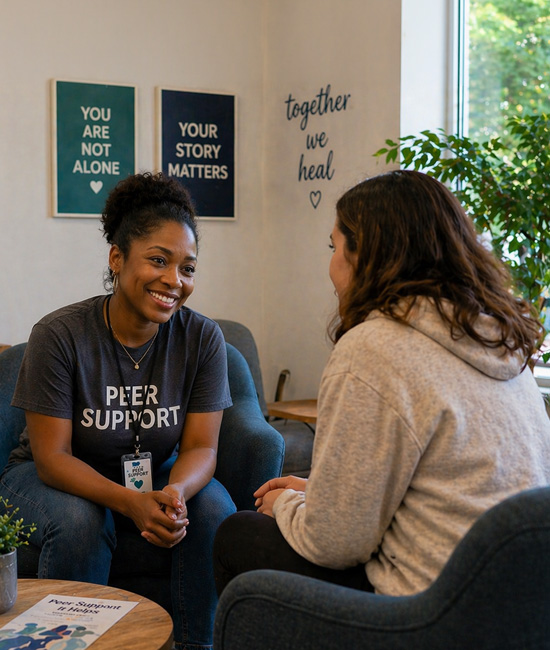
Peer Support
Why We Do What We Do
We are committed to support our consumers in reaching their full potential to thrive as normally as possible in society.
How Can We Help?
As we meet each individual where they are, we will support, advocate and connect them with the proper community resources they may need.
Making An Impact
We desire to make a positive impact in the lives of individuals within our communities. As they navigate their experience with mental health and substance abuse, we will assist them in making the best possible choices for them.